събота, 30 април 2016 г.

An endothermic chemical reaction for closing cycles

                                   External combustion- internal cooling engine


In current engines we use exothermic chemical reactions (chemical  process that releases heat  ) to heat the hot part, so that the heat of the environment to use for a cold part - Chart 1.


https://commons.wikimedia.org/wiki/File%3ARankine_cycle_layout.png 


I would venture to suggest that to using endothermic chemical reaction (chemical reaction in which the system absorbs energy from its surroundings) to cool the cold part, so that the heat of the environment to use to heat the hot part - Chart 2.


Let working substance (γ) of the engine has a boiling point lower than the temperature of the environment - for example, γ is ammonia ( 240K bp). At ambient temperature 290K gases   ammonia have 8MPa pressure and driven turbine (piston). To close the cycle will use an endothermic reaction between two substances α and β to the heat exchange with the gases ammonia, which will liquefy the low temperature caused by a chemical reaction. Let α and β are nitrogen and oxygen, such as by reacting with each other to give Nitrous oxide ( N2O ). This chemical reaction is related to the withdrawal of heat.
Another option (why not essential?) Is α and β are solvent and solute (salts), in mixing that takes heat (endothermic solution). Guess  - When solutions can probably achieve the best option - to crystallize by the heat of the environment?  So we can repeat the process again with the same substances?
Naturally – The unit and processes must be heat insulated  from the environment.

PS I am a supporter on the physical method with use of mechanical power (refrigerator) to obtain the cold in cold part.


2 may 2016

How nice it would be if we have any substances that are interconnected in endothermic reaction and the resulting chemical compound is unstable at ambient temperature! For example we use the chemical reaction between these substances to create a cold area with very low temperatures (to accept lower than 170K), and then after put out the resultant compound from thermal insulated cold part of the unit  to  the environment warm up in which disintegrate? The law of Lavoisier - Laplace collapse will be accompanied by heat, which we can use to heat the hot part of the unit / other unit. Or a catalyst to help the separation / reaction of the substances?
So we can use the same amount of substances repeatedly to provide engine work - a renewable process so that the resulting mechanical energy of the unit will be  100% renewable sources.
I will try to convince chemists that is worth working on. 

3 may 2016

Yes, the idea of ​​cold part created by a chemical reaction is not new to me,  but these days more and more solidified the idea that if there are appropriate substances, such unit will be useful in many cases even more than the aggregate with cold part created by physical methods. Probably chemical method will allow us smaller in size engines with more power . In the chemical method is likely to achieve greater temperature difference between the hot and cold part with less components - compressor dropped  for example.

Of course the comparison between the physical and chemical unit is  possible olny in renewable chemical processes.


4 may 2016


Wanted!   Wanted!

The attention of chemists:
Seek solutions and substances that have properties such substances α and β of Chart 3:
1. To connect  each other in an endothermic reaction (1 on diagram3)
2. The resulting compound / solution is unstable at ambient temperature (2 on diagram3)
3. With some intervention (heating, catalyst spark etc.) unsustainable compound between them to break, assuming that this process is accompanied by heat (3)
4. Divide substances and cooled them to ambient temperature, so that we can fulfill all these four points again

Many thanks 

Svetozar  the Cold


5 may 2016

Looking at chart 3 one might think that the work of such a unit is impossible. At first glance, here is nonsense - two substances are connected and disconnected by chemical reactions, and these two chemical process with the same quantities of materials give us useful mechanical energy ?? This is contrary to the laws of nature - This is so that we can create energy ?? - Impossible!
This is at first glance. Actually we have two heat exchange with the environment -
Position 2 - the compound is heated (assuming energy) from the environment during its transition from cold to warm part
 Position 4 - substances cool - give out energy to the environment in their transition from warm to cold part
These two heat transfer (position 2, 4) form a useful mechanical energy that can be drawn from such an engine, and it is equal to the difference between the amount received heat from the environment during the passage of the compound from the cold to the warm part - Qin , and the amount of given heat the passage of substances from the warm to the cold part - Qout
 Wturbine  = Qin - (- Qout) =  Qin + Qout
In fact - the sum of the amounts of heat exchanged between the substances and the environment.
Perhaps and you ask yourself - Why to use a chemical method once and it useful energy is formed by the heat exchange between a substance and environment as in physical method ?

It should be chemical (assuming that we have renewable chemical processes) take advantage, because the warm part in this method can have a temperature higher than ambient temperature (while in physical strictly confined to the ambient temperature). It will shape a large temperature difference between the hot and cold side of the unit, respectively greater useful power.

7 may 2016

Oоps, the formula :Wturbine  = Qin - (- Qout) =  Qin + Qout 
 for useful mechanical energy expressed by the quantities of heat which substances exchange with the environment is wrong.
Although I know that when it comes to converting heat into work before I have to express any statement on the matter have to think twice and still make mistakes to express an opinion without  I have thought many times - I beg your pardon!
This formula will make / destroy energy
Come on, let's remakes:

By the law conservation of energy: the sum of the mechanical energy produced by the converter on heat into mechanical energy Wturbine  and Qout must be equal to  amount  of heat given from the environment on the compound / solution - Qin
The mechanical energy from the turbine will turn into heat and to be not create / destroy energy should have the following equality:

Wturbine + Qout  = Qin 

so that:

Wturbine  = Qin -  Qout

I will use the case that I am in mine blog to present an analogy on external combustion - internal cooling engine . Because of frequent disputes if possible: the conversion of heat on the environment into mechanical energy, which will inevitably turn into heat and this circle of energy is repeated , want to give an analogy that I think is relevant (It applies to aggregate filled in the physical method, but probably appropriate in aggregate performed by chemical methods with renewable chemical processes):

Will compare unit with a dam and power plant. The thermal insulation of the engine is the sluice that barred the river. If we have a river /  environment with a suitable temperature; and a turbine, to obtain mechanical energy than we should to dam the river / to insulated unit. The river will fill dam / should  need more investment - to cool the cold part by external force ..... in both cases nature will do the rest. 

External combustion - internal cooling engine - This definition is probably not appropriate for the engine as this on chart  3, but the definition suggest to refine when we find a renewable chemical process.

P.S.  
 Because I feel that I have nothing more to add on the subject external combustion - internal cooling engine,  I will concentrate on one of my "old love" and in the next few years (maybe soon) will present a theory that is in another area other than physics - To make a announcement :
If you see Svetozar the... (I have not yet decided what) to advertise a theory - read! I hope that will be interesting and will not waste time in vain.


четвъртък, 10 март 2016 г.

Rankin cycle § Zero cycle on pistons

             External combustion- internal cooling engine with two                             working substances on pistons§cylinders

                 (Rankin cycle and zero cycle on pistons)
                         

I will present some reflections on the use of two working substances (with different boiling points) who work in thermally isolated environment by pistons. I will discuss several phases of performing a work of the substances and phase of application of force on one of them, and next week will try to connect them in a "analog" type who will represent external combustion- internal cooling engine of two working substances filled with pistons .
Let us have two Dewar containers with two working substances in liquid state. One with a high boiling point will call it Alpha, and the other with a low boiling point will call it Beta substance. The containers are connected to the cylinders in which the pistons move.
All processes of course developed in thermal insulated environment.
Let in one Dewar have some amount of liquid substance Alpha with a temperature higher than its boiling point -T1 on diagram 1.


 The container is connected to the cylinder and piston position A on diagram1. We put weight N kg. the piston for opening the valve substance will expand (evaporate) and pushed the piston - respectively the weight of a distance -position B. Let equilibrium between the pressure in the container and the weight on the piston is in such an increase in volume, wherein the substance cools down to a temperature T2 = (T1 - Tbp) / 2,where Tbp is a boiling point of the substance.
In another Dewar we have some amount of liquid substance Beta at temperature T1 which is the initial temperature of Alpha. Container is also connected to the cylinder/piston - chart 2.


 We take gas from cylinders of the substance Alpha and put them in a heat exchanger to a container of the substance Beta.  On the piston put weight equal to ½ of  weight N where Alpha is in equilibrium at T2. Let the amount of the substance Beta be such that upon opening of the valve together with the gases of Alpha gravity move the same distance, and the system goes into equilibrium at a temperature T3 equal to the boiling point of the Alpha - position B in diagram 2. In its equilibrium position volume on Beta has been extended so that the temperature of the two substances (beta has a low boiling point and  heat exchange between them) is equal to the boiling point of the Alpha - gases Alpha liquefies at equilibrium of the gas pressure of the Beta and weight equal to to ½ of gravity N.
Now I want to discuss the question - What is the smallest weight that if we put on the piston to return it to the starting position - to return to the starting position parameters of volume, pressure and temperature of the substances in these processes of charts 1 and 2? By low conservation of energy this will be another added weight Nkg for Alpha, and 1 / 2Nkg for Beta -  chart 1a for Alpha, 


  and charts 2a and 2b for Beta.


 As work has made the substance, so the force applied to it to perform the same work on it, and the substance returns to its initial values ​​of temperature, volume and pressure .
 Let pistons of the two containers with different substances are connected to the "scale" - diagram 3a,


 or better of the crankshaft in the opposite direction of movement -  diagram 3c.


 In the condition of opening the valve Alpha will be in equilibrium with the weight Nkg. and Beta by weight 1 / 2Nkg  i.e. the piston of Alpha acting force twice larger than the force on the piston Beta. Alpha substance has power precisely so as to return the substance beta to its initial state after opening the valves (as I follow the logic of the previous charts 1a, 2a and 2b) - diagrams 3b; 3d


 3d.


 The temperature of Alpha in the container and cylinder (liquids and gases)  in equilibrium position by default  (position b) T2 = (T1 -Tbp) / 2, and the temperature of Beta in position b (its initial state) is T1, respectively liquid  Alpha which heat exchange with Beta also has a temperature T1.
If  I remove the liquid Alpha from heat exchanger , and in its place put gas Alpha from cylinder will return to the starting position at which gases Alfa at temperature T2 and liquid Beta at temperature T1 perform work as push the piston respectively gravity 1 / 2Nkg to their equilibrium position as I start  - diagrams 4a; 4b; 4c .

To return to the starting position the container with liquid Alpha substance must be heated liquid alpha in the container of temperature T2 to temperature T1. This heat has turned into mechanical energy.


4c start (end) position


Discussed above processes and actions with both substances Alpha and Beta them harnessed in one unit to perform work on behalf of a heat source. Naturally as with any patterns external combustion - internal cooling engine heat source can be the environment -  Alpha substance must must be a boiling point lower than ambient temperature. These few several phases of action I arrange them in a station that end (or initial) phase  performs some work (raising the weight 1 / 2 Nkg ,of gases on substance Alpha, and substance Beta ,where the Nkg it is the strength of the alpha) on account of the heat source. I summarized :
 Based on pre-set temperatures, quantities and volumes of two working substances can receive mechanical force as one substance - Alpha gets heat from source and works in Rankin cycle, and other Beta participate in the closing cycle on Alpha, and in start / end point its parameters remain unchanged ( Zero cycle).


To be continued


P.S. Right now I would like to propose for discussion a more interesting situation - Gases Alpha and Beta liquid heat exchange and perform work, so in their equilibrium position with weight 1 / 2n on the piston in the container temperature is close to freezing point of Alfa -  diagram 5.


 Let's Alpha be ammonia ( 240K bp, 196K mp) and Beta is nitrogen (77K bp). Let quantities Alpha and Beta are such that in the equilibrium position - position B from a temperature of 300K and 270K of nitrogen and ammonia gases temperature  decreased  to 200K - close to the freezing point of the ammonia,due to the increase a volume on Beta . Now when I open the valve will have two forces - a piston which rises weight 1 / 2N kg, and another piston  - over ammonia gases,   due to contraction of temperature close to freezing point rise weight Xkg. Total work done from position A to position B will proportional on 1/ 2N kg + Xkg. What weight can raise (to N eventually) I do not know. I would prefer to check it empirically :)

11.03.2016
Another more close to our ideas example of a puzzle with the force of contraction - diagram 5a


To be continued

12.03.2016
Here are the reviewed processes in unit - two working substances on pistons - diagram 6


indications:
1 - double-acting piston
2 - evaporator
3 - compression container
4 - valve
5 - reducer valve
6 - heat exchanger with the heat source
7 - pump
8 - heat exchanger
Good external combustion - internal cooling engine must have a good thermal insulation. In the case shall the pistons and cylinders must to be of materials with low thermal conductivity.


вторник, 16 февруари 2016 г.

Theory on the topic: "Two working substances with a common cold part "

I will try to theorize on topic:  "Two working substances with different boiling point with common cold  part"
I'll start with a simple understanding of the process of converting heat into mechanical energy. (And conversion of mechanical energy into heat)
Let us have a particle substance in the cylinder piston. Let the particle be at a temperature T1  higher than the boiling point of the substance diagram 1.


 Let the other fraction of the same substance at a temperature equal to the boiling point of the substance Tbp  stands from other parts of the piston (A). Assume an ideal option where the piston will mass and heat isolation - no heat loss. When a hot particle hits the  piston that in turn will hit the particle on the other side (B) and so the two particles will catch your energies, your temperature accordingly (C). If the temperature - both particles will have a temperature( T1 – Tbp  )/ 2. So I can make the following conclusion:
In Idel version maximum work that can be done given amount of working substance  in a converter  on heat into mechanical energy (whether in the cylinder piston or turbine) is equal to the equivalent of the arithmetical average its temperature and its boiling point
W= cm(T1 - Tbp)/2


If  I put a transformer  of heat into mechanical energy diagram 2, 2a (turbine on diagram) between the two tanks with a liquid substance, one has a temperature above the boiling point T1 , and the other has a temperature equal to the boiling point of a substance Tbp ,this turbine will perform work equivalent to (T1 – Tbp) / 2. If work done on the substance that comes out of the turbine with a compressor and reducing valve,equal work which is carried turbine then after valve parameters of substance must return to the starting position - the work is performed, the work done on it and temperature, volume and pressure at the beginning of the process and at the end of the processes are the same.
So when we use work to close the cycle of a working substance can not it remain useful energy - the mechanical force we have received, so we have to use on the working substance to close the cycle .
This cycle will call it - ZERO cycle.


Let us have two substances with different boiling point chart 3. The first working substance- A has a higher boiling point than second -  B.  For each substance have a two tanks, one being at a temperature higher than their boiling point – T1 , the other at a temperature equal to its boiling point - Tbp. The temperature of the substance B in the hot reservoir is equal to (T1a - Tbpa) / 2. Connect turbines and compressors to tanks. Both substances have zero cycle  - as the work carried out,  so the work we perform on them working substances. Will unite hot and cold tanks of both substances (hot to hot tank 6a;6b ,cold with cold tank5a;5b) to heat exchange with each other.
Let the amount of circulating substances are such that the cold part due to heat exchange the temperature of the two substances is equal to the boiling point of the substance at a high temperature - the first substance is liquefied. So after the heat exchange between the two substances first liquefies. This defeats the compressor 4 and the reducing valve 7a.  Compressor 4 and  valve   became pump diagram 4. 


 So the zero cycle of the first substance(ammonia on diagram 4) becomes familiar Rankine Cycle which we use in external combustion engine.
Due to heat exchange conducted between the two substances in  their the cold and warm tanks, compressor 3 will operate at  high temperatures  than turbine 2, but at the same temperature range, which preserves the balance of carried to the attached forces (Win / Wout) operation for the second working substance .

By combining hot and cold tanks of two Zero cycle, this cycle with high boiling point is converted in to Rankin cycle.

18.02.2016
For me remains unclear whether we can reach a temperature of the first working substance at outlet lower than (Tenv + Tbp)/2 (the average of ambient temperature and boiling point).Whether we can set at practice the following temperatures as chart 5:
200K of the heat exchanger 5 (close to the melting point of ammonia)
 210K heat exchanger 6
and keep them?


As  lower temperatures achieved (as long as they do not extend below the melting point :)) in the cold part - the higher the useful power will have the unit. Though 10 degrees difference do our work, I mean that after an initial "investment" - setting the cold part, will not be necessary "to spend a penny more."

20.02.2016

QUANTITIES OF HEAT AND WORK

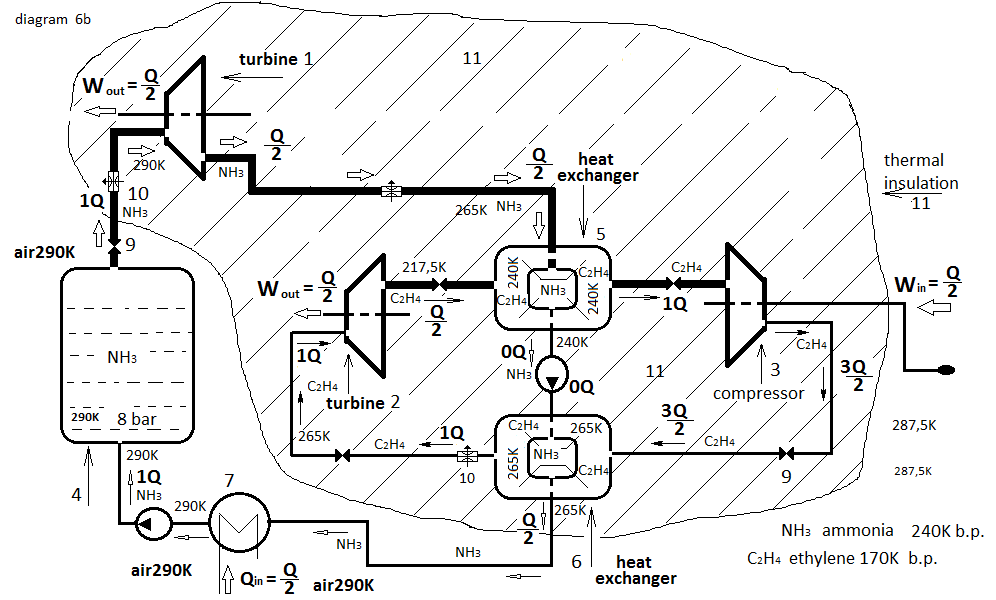
 Rankine cycle -diagram 6; Zero cycle -diagram 6a; Unit with two zero cycle with a common cold part- diagram 6b
Accept that a working substance at a temperature equal to its boiling point no pressure in the evaporator and can not perform work, so that will denote the amount of heat that has this substance 0Q.
Will denote the amount of heat that gets working substance from the heater with 1Q.
In the simplified version of the energy conversion (charts 1 and 2)


 Rankine cycle -diagrama 6
After heater 1Q
After turbine 1 / 2Q. As a result of work done by the turbine 1 / 2Q turns into mechanical energy and then have a working turbine substance with 1 / 2Q heat
After the heat exchanger - 0Q. Cooled heat exchanger working substance to its boiling point and after it has heat 0Q
Heater heated working substance, giving it heat 1Q


Zero cycle -diagram 6a
After heater 1Q
After turbine 1/2 Q .  1/2 Q heat has become mechanical energy
 After the compressor - 1Q. Compressor performs work equal to 1 / 2Q to liquefy the working substance in which mechanical energy is converted into heat, so after reducing valve total amount of heat which has the working substance is 1 / 2Q +1 / 2Q = 1Q
 So working substance with 1Q heat energy enters the heater and after him have the same heat. Zero cycle - 0Q heat has turned into mechanical energy


Two zero cycle with a common cold part - chart 6b

The first working substance
After  heater 1Q
 After 1 turbine 1/2Q
 After heat exchange performed in a heat exchanger 5 0Q
1 / 2Q after heat exchange with the second working substance in a heat exchanger 6
1Q after the heater is increased heat energiya- 1 / 2Q +1 / 2 Q = 1Q

The second working substance
 1Q  after heat exchange in heat exchanger 5 with the first working substance 
 Compressor performs work such as mechanical energy equal to 1 / 2Q becomes heat -1Q + 1/2Q = 
 = 3 / 2Q after compressor
1Q after the heat exchange in heat exchanger 6
1 / 2Q after turbine 2
1Q after heatexchanger 5

1 / 2Q thermal energy is converted into mechanical energy of the unit with two working substances with a common cold part compared to Rankine cycle

понеделник, 1 февруари 2016 г.

Two working substances with a common cold part as to start the internal cooling

Reflecting on the method for converting heat into mechanical energy that the cold part I create by doing work I saw an untapped so far from me the opportunity for effective work - It would be better to replace expansion valve on "refrigerator"with a turbine  (or piston / cylinder; generally speaking converter heat into mechanical energy) diagram (1a)( 1).


 On both sides of the expansion valve system for redistributing heat ("refrigerator") there is a temperature difference (differential pressure) which is a prerequisite turbine to perform work. By doing this work converter of heat into mechanical energy (as well as all others who work in the method) achieved two important goals for us:
- Mechanical energy
- Cold
The mechanical energy is our goal, and the cold part we need in the process of internal cooling in the absence of such a natural.
Let the operating cycle of the n-th working substance creating cold part by using cooler. Replace the expansion valve with a turbine. We now have a further beneficial force that is a result of the conversion of heat into mechanical energy.
Replacing expansion valve with turbine converts refrigerant in working  substance. Now in the cold part (the last n-th cycle of the working substance with the lowest boiling point) have two working substances with a common cold part - the cold part of the system for redistributing heat.
In the cold part  the working substance liquefies because of the low temperature generated in the expansion of refrigerant due to the compressor. In the warm part of the working cycle of the refrigerant already liquid working substance is heated with the same amount of heat which is taken away from him at liquefaction. Thus, after the heat exchanger in the hot part will have a liquid working substance having a temperature  ½ of the difference between the temperature on entry into the turbine and its boiling point
 Working cycle on refrigerant becomes neutral - no change in temperatures, considering that the same amount of heat is removed and transferred from refrigerant gas at working substance. Therefore  the work of the compressor and turbine are the same -  as the mechanical power is converted into heat in the course of operation of the compressor on refrigerant,  so the same heat turbine is turned into mechanical power. Cycle on refrigerant agent is a neutral shade.
Energy balance  on n-th working substance + refrigerant (provided that the turbines convert 50% of the heat into mechanical energy) will be:

A zero cycle – the  "refrigerator"
A cycle in which 50% of the heat is converted into mechanical energy - the working substance
The outcome of the two cycles is a liquid  working substance with  a temperature 1/2 of the difference between its temperature before entering the turbine and then the heat exchanger in the hot part of the "fridge".
Thus, in the last cycle (n) working substance decelerated for some amount of heat as has become a mechanical energy,  whereby  cooled the previous(n-1) to allow the unit to operate.

Now I can not go back heat into the evaporator  - diagram 2


Variant of еngine with two working substances (ammonia and ethylene in the case) - chart 3

In optimal load of the turbine and compressor at best we can achieve a temperature difference between input and output = (Tenv - Tbp) / 2
where :  Tenv- temperature on environment; 
              Tbp - boiling point of the first working substance
The power will be expressed (ideally):

P = cm (Tenv - Tbp) / 2

where: c - specific heat capacity of the first working substance
            m - mass of first working substance circulating for a given time


Note again: As with all engine variants of the external combustion - internal cooling method cold/s part create it beforehand using external force.